WCRI 2026: The World Conference on Research Integrity in Vancouver

About WCRI
The World Conference on Research Integrity (WCRI) is one of the leading global forums for advancing responsible research. It unites scientists, publishers, institutions, and policymakers who work to strengthen trust, ethics, and accountability in science. WCRI Conference 2026 will focus on three major themes: Artificial Intelligence, Research Security, and Indigenous Knowledge Systems.
WCRI 2026 Themes
Each edition of the World Conference on Research Integrity focuses on key issues that shape how science evolves. The 2026 conference highlights the following:
Artificial Intelligence and Integrity in Scientific Research
AI now plays a central role in how research is created, verified, and shared. It can expose image or data manipulation that might otherwise go unnoticed, exactly what drives Imagetwin’s mission. At the same time, AI also introduces new risks: fabricated results, biased outputs, and unethical use of generative tools. The conference will explore both sides of this shift – how to use AI responsibly while keeping human judgment and transparency at the heart of science.
Research Security and Openness
Modern research depends on collaboration, but it also faces growing security challenges. Governments and institutions must protect sensitive data, intellectual property, and national interests without limiting the open exchange that fuels discovery. WCRI 2026 will focus on this balance: how to keep science transparent and trustworthy while addressing issues such as restricted partnerships, data access, and foreign influence.
Indigenous Knowledge and Ethical Research
This theme highlights the importance of Indigenous perspectives in global research ethics. It calls for genuine engagement with Indigenous ways of knowing and for a deeper respect for community-based research practices. By bringing these voices into the conversation, WCRI 2026 broadens what integrity means: compliance with global standards, cultural awareness, respect, and shared responsibility in how knowledge is created.
Imagetwin at WCRI 2026
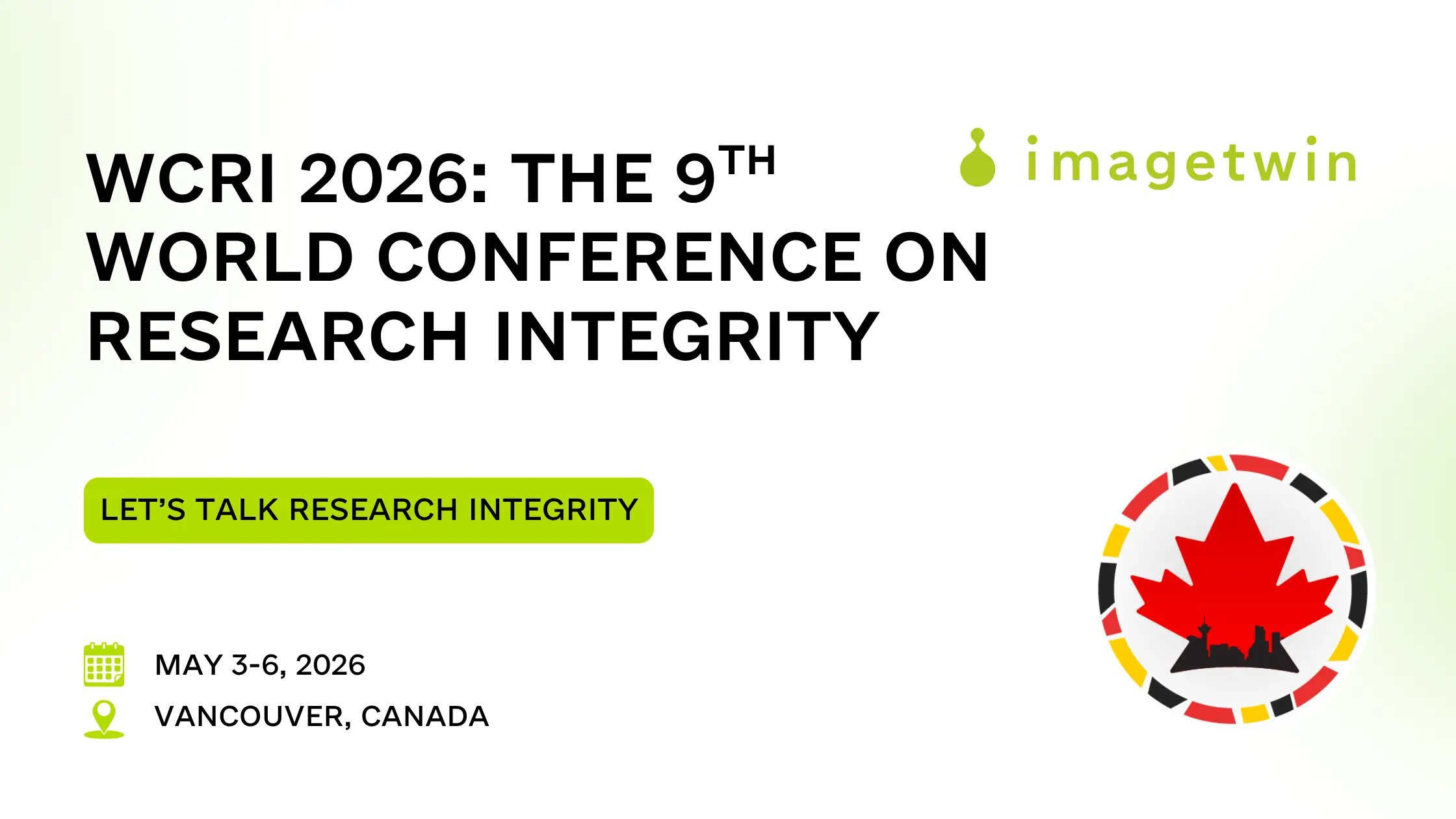
Imagetwin will exhibit at the 9th World Conference on Research Integrity in Vancouver, Canada. WCRI’s mission aligns closely with ours: to promote transparency, accountability, and trust in scientific research.
Our AI-driven technology helps researchers, publishers, and institutions detect image duplication, plagiarism, manipulation, and AI-image fabrication before publication. We help protect research credibility and uphold the ethical standards that WCRI stands for by making image verification fast and reliable
We look forward to joining this global conversation on responsible and ethical research, since it will give our team a chance to connect with integrity leaders, exchange insights, and explore how technology can preserve trust in science.
Visit us at our booth at WCRI 2026 to discuss potential collaborations to support research integrity worldwide.
WCRI Sign Up & Schedule
The 9th World Conference on Research Integrity (WCRI 2026) will take place from May 3–6, 2026, at The Westin Bayshore Hotel in Vancouver, British Columbia, Canada. It is open to researchers, institutions, and policymakers worldwide.
For more information, visit the official WCRI Canada website for updates on registration, travel, and the full schedule.
About Imagetwin
Imagetwin uses artificial intelligence to verify the integrity of scientific images. Our platform helps publishers, universities, institutions, researchers detect image integrity issues, prevent fraud, and protect scientific credibility at scale. With a mission to make research more transparent and trustworthy, Imagetwin partners with the global scientific community to ensure that published findings reflect genuine, reproducible work.
If you’d like to learn how Imagetwin supports research integrity or explore potential collaboration, reach out to our team.
Frequently asked questions
How do I find out if an image in a submission was AI-generated?
Imagetwin includes automated AI-generated image detection as part of its standard screening. When a manuscript is submitted through an integrated platform such as ScholarOne, Wiley’s Research Exchange, or Editorial Manager, Imagetwin flags figures that show signs of AI fabrication alongside checks for duplication, manipulation, and plagiarism. As generative AI tools become more accessible, this type of automated detection at submission is increasingly essential for maintaining the credibility of published research.
What are the most common ways figures get manipulated in research papers?
Imagetwin analyzes images for manipulation automatically, covering splice detection, copy-paste forgeries, and cross-publication reuse. For Western blots specifically, it produces a color-coded overlay highlighting suspicious regions, with a false positive rate of 1.7%. For manual review, signals to watch for include images that look suspiciously similar in texture or lighting, low-resolution JPEGs where originals should be high quality, and labels or text obscuring image corners. Automated screening with Imagetwin catches what manual review misses, particularly at scale.
How does Imagetwin work?
The most frequently detected issues are Western blot splicing (vertical or horizontal cuts that combine bands from different experiments), copy-paste duplication within or across figures, microscopy images reused across multiple papers or disease models, and figures taken from unrelated publications and relabeled. AI-generated figures are an emerging category. In a Radboud university medical center investigation of 608 pre-clinical stroke research papers, approximately 40% of articles contained image-related concerns, predominantly duplicated Western blot panels.