Stronger Western Blot Manipulation Detection

Western Blot Manipulation Detection

Imagetwin’s manipulation detection now covers a broader range of alterations in Western blots, and does so even more accurately than before.

What's New

We have released a new detection model that expands coverage and improves accuracy across all manipulation types:

  • Vertical splices: the most common type flagged on PubPeer
  • Horizontal splices: typically indicative of deliberate alteration
  • Copy-paste forgeries: detected where the manipulation results in at least a partial alteration around the forged area
 

Previously, these were treated as separate detection tasks. Going forward, we handle them under a single umbrella: manipulation detection. Whether a region was spliced in or cloned from elsewhere, what matters is that the image shows an inconsistency, and we flag it.

Detection Performance

The new model outperforms its predecessor on every metric we track:

  • False positive rate down from 2.4% to 1.7%
  • Detection rate up by 14 percentage points on splices
  • Additional gains on copy-paste forgeries and horizontal splices

What You See in the Interface

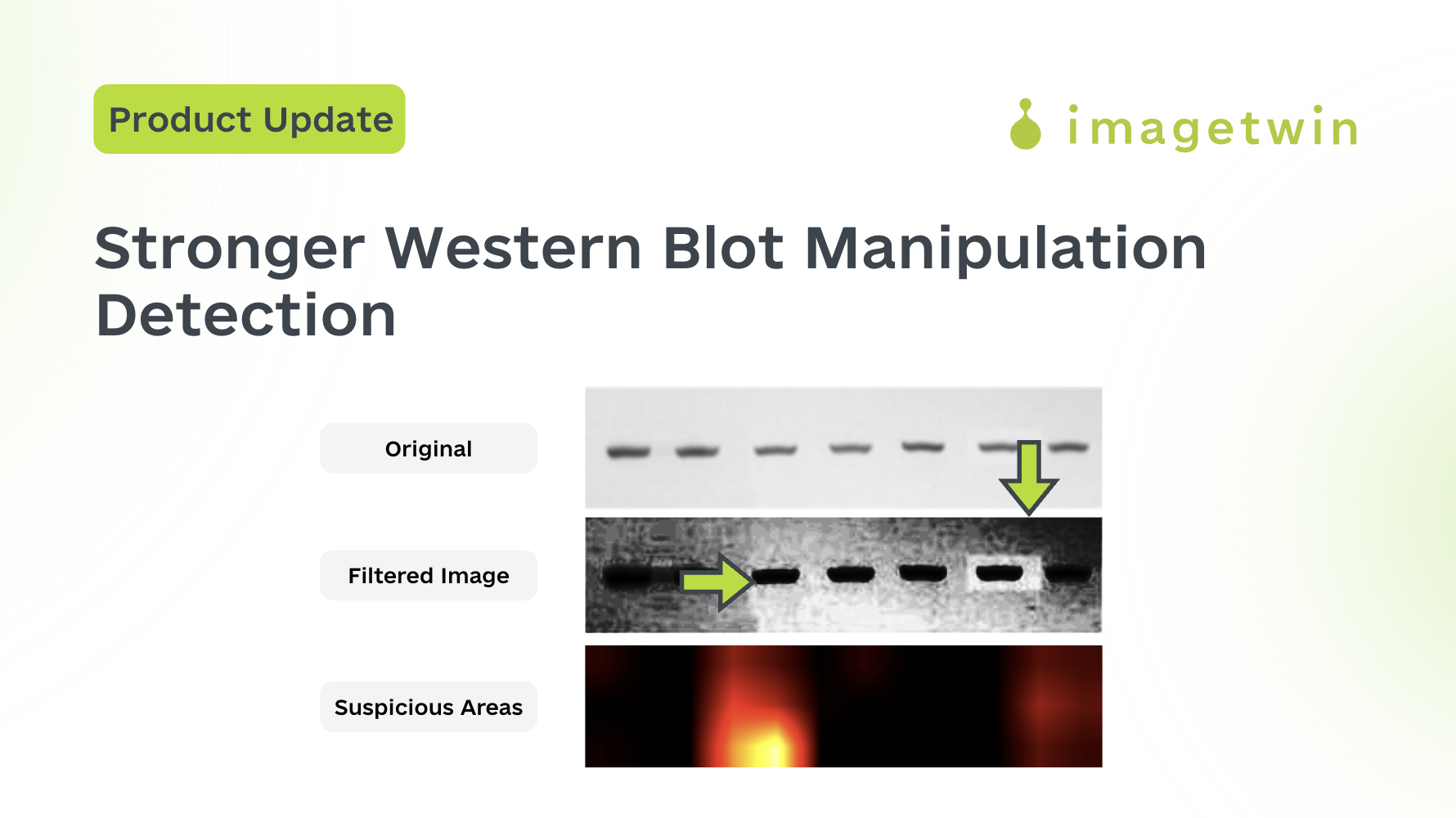
When a Western blot is flagged, you now see two things: the original panel, and a color-coded version of it where suspicious regions are highlighted. Areas of concern appear in color – the brighter, the more suspicious. You can adjust the transparency and apply filters to either or both sides to investigate further.

The overall result is summarized as a single alteration score for the image. If something looks off, it shows as “1 Alteration,” regardless of whether it’s a splice, a horizontal cut, or a copy-paste forgery.

Looking Ahead

Western blots are just the beginning. We are currently looking into extending manipulation detection to other image types, such as microscopic images, FACS plots, and light photography.

Manipulation detection is available through the web application and the API.