Case Study: How ASM Strengthens Image Integrity Screening with Imagetwin

By  Sofiia |
Case Study: How ASM Strengthens Image Integrity Screening with Imagetwin

How ASM Uses Imagetwin

The American Society for Microbiology (ASM) is one of the largest life science societies and a nonprofit publisher of 17 scientific journals. Maintaining trust in published research is central to its mission. To strengthen its integrity screening process, ASM integrated Imagetwin into its editorial workflow in 2023.

Since then, ASM has processed nearly 13,000 scans through Imagetwin, including both direct usage and additional screening via an external service provider.

Imagetwin is primarily used by ASM’s Ethics and Integrity team, where where scientifically trained team members conduct image screening as part of routine editorial checks. The team uses the platform in three main ways.

  1. Routine prescreening of figures

All manuscripts containing halftone images (microscopy, gels, immunofluorescence) are screened for potential image duplication during the revision or resubmission stage – the same stage where other ethics checks, such as text similarity, are performed.

The Ethics and Integrity team reviews the Imagetwin report and evaluates flagged images. Flagged images are first manually reviewed by a specialist using expert visual inspection, then verified using Adobe Photoshop’s Difference function to reduce false positives.

  1. Verification of corrected figures

When authors revise figures after duplication concerns have been raised, Imagetwin is used again to verify that previously identified issues have been resolved, and no new duplications have been introduced. The second check ensures that corrections fully address all concerns.

  1. Assessment of post-publication image concerns

When concerns about potential image duplication in published articles are raised by readers or other third parties, Imagetwin is used to assess the reported issue and conduct a broader review of the article’s figures. In addition to validating the specific concern, the scan helps identify any additional image duplications that may not have been initially reported. This comprehensive review enables the Ethics and Integrity team to address all image-related concerns at once, helping ensure that any necessary corrections are complete and minimizing the need for multiple post-publication corrective measures.

Key Numbers From The ASM Pilot

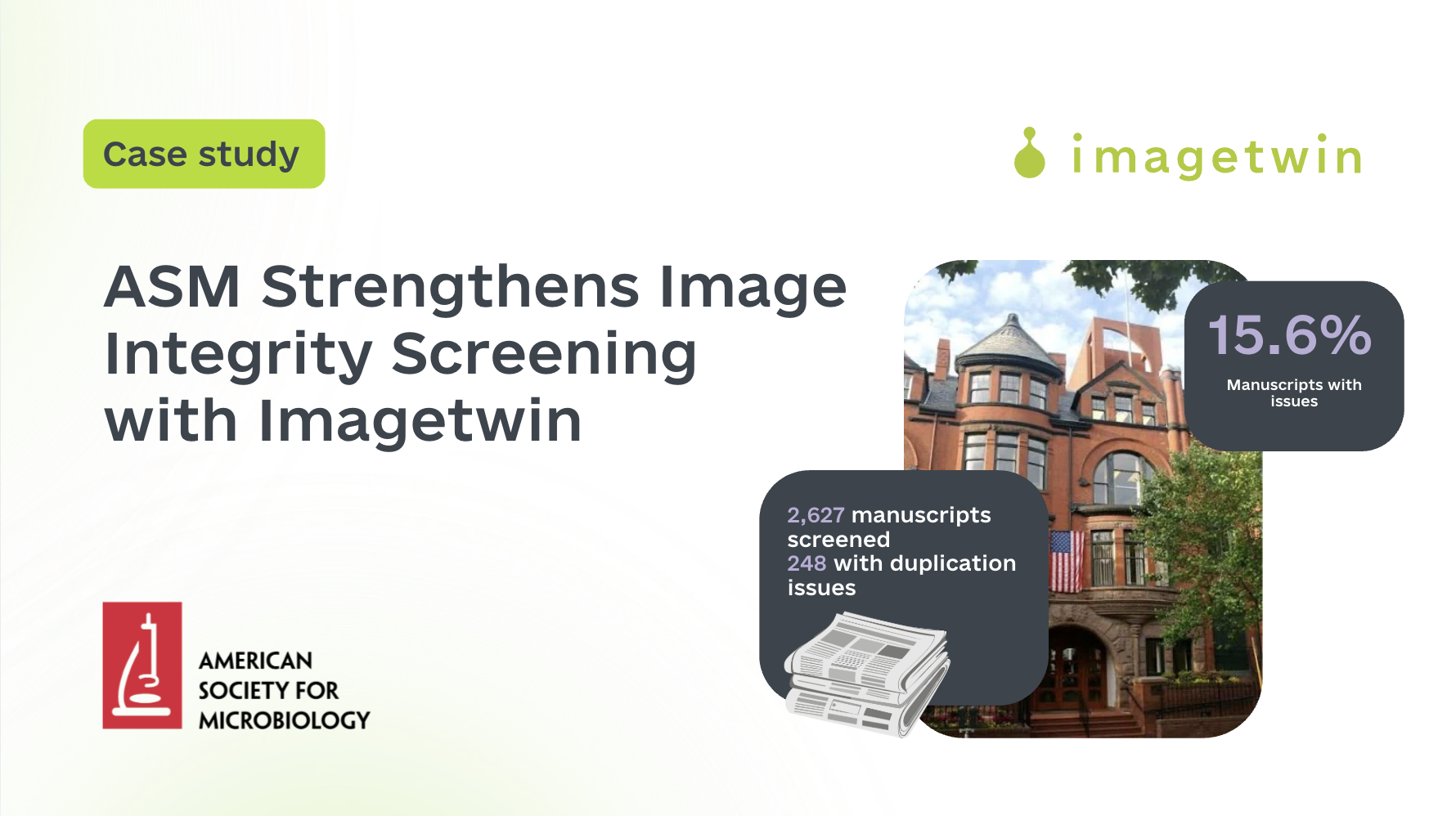
During a one-year pilot (March 2023 – March 2024), ASM screened 2,627 manuscripts from 15 journals at the post-acceptance stage. The pilot launched initially with Microbiology Spectrum for one month before expanding to all ASM journals.

Key findings published:

  • 410 out of 2,627 screened manuscripts (~15.6%) showed image-related concerns overall
  • 9% of accepted manuscripts (248 out of 6,416) that had already passed peer review contained image duplication issues detected before publication
  • Image duplication accounted for approximately 60% of all figure-related concerns
  • Resolving issues pre-publication required ~1.5 hours on average, compared to up to 10 hours post-publication
  • In 50% of editorial consults (6 manuscripts), acceptance was revoked due to insufficient author response or lack of original data


Most Valuable Capabilities

According to the ASM team, the most valuable functionality has been duplication detection and cross-publication image reuse detection. Imagetwin can identify when images from previously published papers appear in a new submission, allowing editorial teams to review whether the reuse is legitimate or problematic.


Why ASM Made Image Checks a Standard Part of Review

Image duplication in scientific publications can occur either intentionally or unintentionally. Regardless of the cause, it raises serious concerns.

Duplicated figures can:

  • undermine confidence in the reported findings
  • raise questions about scientific rigor and research practices
  • potentially suggest research misconduct
  • damage the credibility of peer review and editorial oversight
"When images are duplicated in scientific publications, whether by mistake or design, it compromises confidence in the research and those behind it... Ultimately, these practices weaken trust not only in the study itself but across the broader scientific enterprise." — ASM Ethics and Integrity Team

Since 2023, Imagetwin has become an integral part of ASM’s ethics screening workflow across its portfolio of journals. For society members and affiliated journals, this means stronger protection of the scientific record, no risk of reputational harm, transparency in editorial processes, and full trust in the peer review system.

Frequently asked questions

Yes. Imagetwin was used by researchers at Radboud university medical center to screen 608 published papers in a single investigation. Using Imagetwin’s database of 160M+ scientific figures, the team identified image duplications and reuse that would have been impossible to detect manually at that scale. The study, published in PLOS Biology, found image-related concerns in approximately 40% of articles reviewed, including duplicated Western blot panels and reused microscopy images.

Imagetwin is used by research integrity teams at universities and medical centers for large-scale literature investigations. At Radboud university medical center, researchers used Imagetwin over a three-year investigation to screen hundreds of pre-clinical stroke research papers, confirming duplication cases through cross-database comparison. It is also integrated into publisher workflows at Wiley, Karger, and Sage, and into submission systems including ScholarOne Manuscripts.

Imagetwin’s cross-database detection compares submitted or uploaded figures against 160M+ published scientific images, identifying visual overlaps including duplicated Western blots, reused microscopy images, and figures repurposed from unrelated studies. In the Radboud university medical center investigation, it enabled detection of duplications across 608 papers that the research team confirmed would have been extremely difficult or impossible to find manually. Western blot manipulation detection runs at a 1.7% false positive rate.

Protect Research Integrity with Confidence

Start using Imagetwin to detect image integrity issues and support trustworthy research publishing.

Frequently asked questions

Imagetwin is software designed to detect integrity issues in figures of scientific articles. It helps identify inappropriate manipulations and duplications in various figure types, including western blots, microscopy images, and light photography.

Imagetwin is beneficial for researchers, peer reviewers, journal editors, and institutions aiming to uphold the quality and trustworthiness of scientific publications by ensuring the integrity of visual data.

Users can upload a PDF or multiple image files to Imagetwin. The software then scans the content using algorithms and vast databases of published scientific figures to detect potential integrity issues. Within seconds, results are presented through a web interface, highlighting any detected problems for review.

Yes, we prioritize data privacy and security, ensuring that all image indexing and exchanges are protected with industry-standard encryption and security best practices.

Create an account and start using Imagetwin immediately. We prepared a few example documents that you can scan free of charge.

Yes, Imagetwin is a powerful addition to the peer-review process. It automatically detects various integrity issues, which can then be quickly verified by a reviewer, enhancing the efficiency and accuracy of the review process. Imagetwin also partners with industry leaders in publishing and scholarly workflows, such as Morressier, TNQ Technologies and more, transforming how research is submitted, reviewed and published.

For more detailed guidance on using Imagetwin, contact our support team through our Contact Us page.