Beta Version for Detecting AI-Generated Images

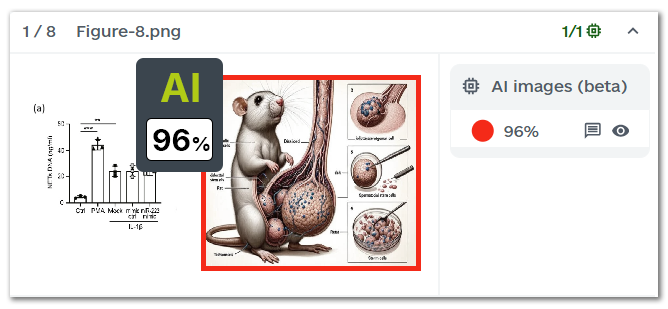
We are excited to introduce a major new capability in Imagetwin: AI-generated image detection is now available. With the rapid advancements in generative models, detecting AI-generated images in research papers has become more challenging than ever. To assist you in differentiating between real and synthetic content, we have just launched a beta version for detecting AI-generated images in scientific articles.
Each paper checked by Imagetwin will now also be scanned using our AI detector for images to help researchers identify manipulated visuals. In this post, we focus on the capabilities, current progress, and roadmap for detecting AI-generated images with Imagetwin.
Detecting AI-Generated Images in Science
Existing AI detection models are not optimized for scientific images. We tested freely and commercially available APIs and observed low detection rates and high false-positive rates for domain-specific images, such as western blots and microscopic images. To address this, we trained our own detection model using images from research articles.
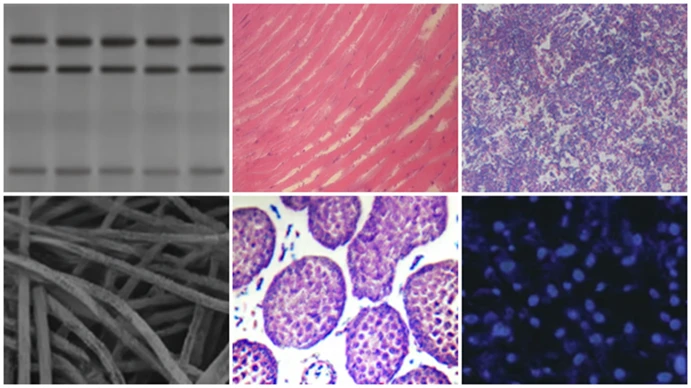
We generated thousands of AI images using image-to-image, text-to-image, and inpainting (a technique to modify specific parts of an image). We applied transformations like cropping, rotation, and scaling to these images during training to ensure robustness. Examples of AI-generated images used for training and testing are shown below.
Beta Version of Our AI Image Checker
While detecting AI-generated images in science remains technically challenging, this beta release offers a promising first step. The feature is an early beta version that can be disabled in your account settings. Below, we outline key areas of improvement and our roadmap for future updates.
Coverage of Generative Models
Our detection method is optimized for a widely used model for generating scientific images. However, many AI models are currently available, with new ones emerging monthly. As we expand our dataset, we are prioritizing the most common generative models to improve detection accuracy and adaptability.
Image Types
The detection model is optimized for domain-specific images commonly targeted for data manipulation, including microscopy images, western blots, histology/pathology slides, cell cultures, and spot images. It is not, however, trained to detect non-scientific photos (e.g., cats, dogs, or unicorns). Future versions will expand training to include a broader spectrum of scientific imagery, such as plots, graphs, and light photography.
Explainability
One major challenge with flagged images is distinguishing false positives from actual AI-generated content. We are actively exploring solutions to enhance explainability, making it easier to interpret flagged cases. In the meantime, consider the following checks to evaluate detected cases:
- Check for implausible visual cues, such as incomplete or nonsensical text (a common weakness in generative models).
- Review figure labels and textual descriptions for consistency.
- Consider frequency: Multiple flagged images in a paper increase the likelihood of AI-generated content.
- Verify publication dates: Images published before the rise of sophisticated generative models (pre-2022) are unlikely AI-generated.
- Consult authors for original data if uncertainty remains.
The beta release for detecting AI-generated images marks a pivotal step in strengthening research integrity. We are continuously improving our detection models and welcome your feedback as we work towards full-scale, reliable detection of AI-generated scientific imagery.
Frequently asked questions
How do I find out if an image in a submission was AI-generated?
Imagetwin’s AI-generated image detection is trained specifically on scientific images including Western blots, microscopy images, histology slides, cell cultures, and spot images. Generic AI detectors perform poorly on domain-specific scientific content; Imagetwin built its own detection model using thousands of AI-generated scientific images across text-to-image, image-to-image, and inpainting workflows. Each scan returns a confidence score and model attribution showing which generator likely produced the flagged image. Detection covers DALL·E 3, Stable Diffusion, Adobe Firefly, and other widely used generative tools.
What are the best AI tools for detecting fabricated images in research papers?
Imagetwin is the only image integrity platform with detection models trained specifically on scientific image types. Off-the-shelf AI detectors show low detection rates and high false positive rates on domain-specific content like Western blots and microscopy images. Imagetwin addresses this by training on thousands of AI-generated scientific figures with robustness testing across cropping, rotation, scaling, and other common transformations. It is integrated into ScholarOne, Editorial Manager, Wiley’s Research Exchange, Signals, Integra’s EditorialPilot, CACTUS’s Paperpal Preflight, Rivyr, and Clear Skies’ Oversight.
Is Imagetwin worth it for a journal screening AI-generated figures?
Yes, particularly because generic AI detection tools are not optimized for scientific imagery. Imagetwin’s detection model was purpose-built for the image types most commonly targeted for fabrication in research: Western blots, microscopy, histology, and cell culture images. It runs automatically alongside duplication, manipulation, and plagiarism checks in a single scan, is priced per paper rather than per sub-image, and is trusted by publishers including Wiley, Karger, Sage, ASM, and FASEB across thousands of journals.