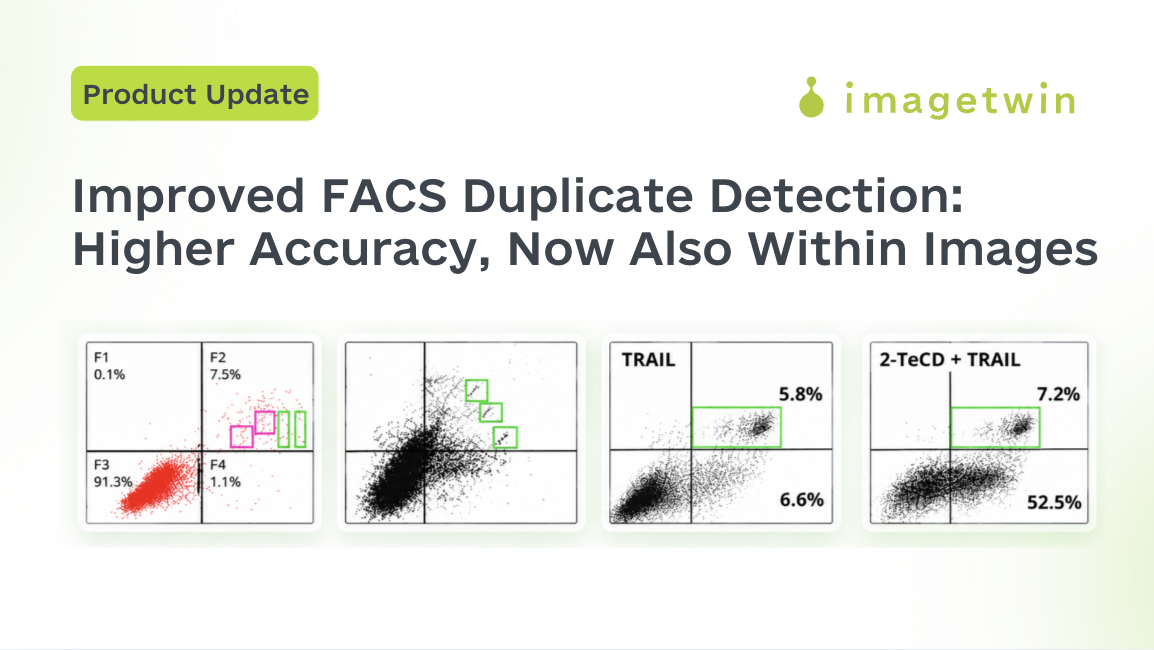
Flow cytometry plots are some of the hardest images to check by eye. Thousands of tiny dots, dense clusters, and gates that look alike across experiments. A copied cluster can easily be unnoticed in plain sight.
That’s why we’re launching the new duplicate detection technology for FACS (fluorescence-activated cell sorting) images.
What's new
Recently, we introduced a new detection technology for western blots. We have now applied the same approach to FACS images, and the results follow the same pattern: a significant improvement in detection rates.
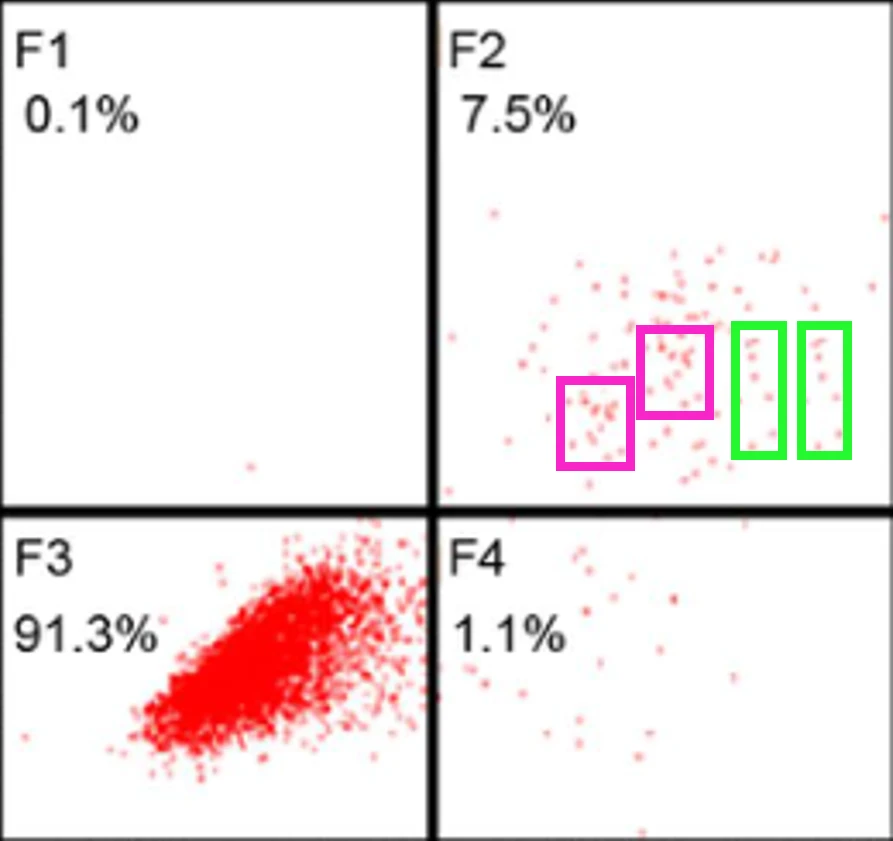
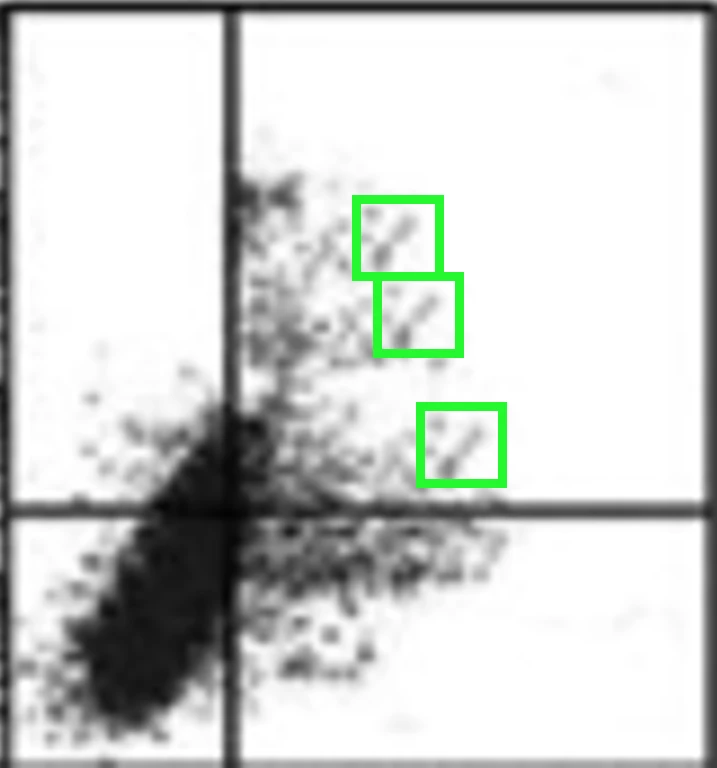
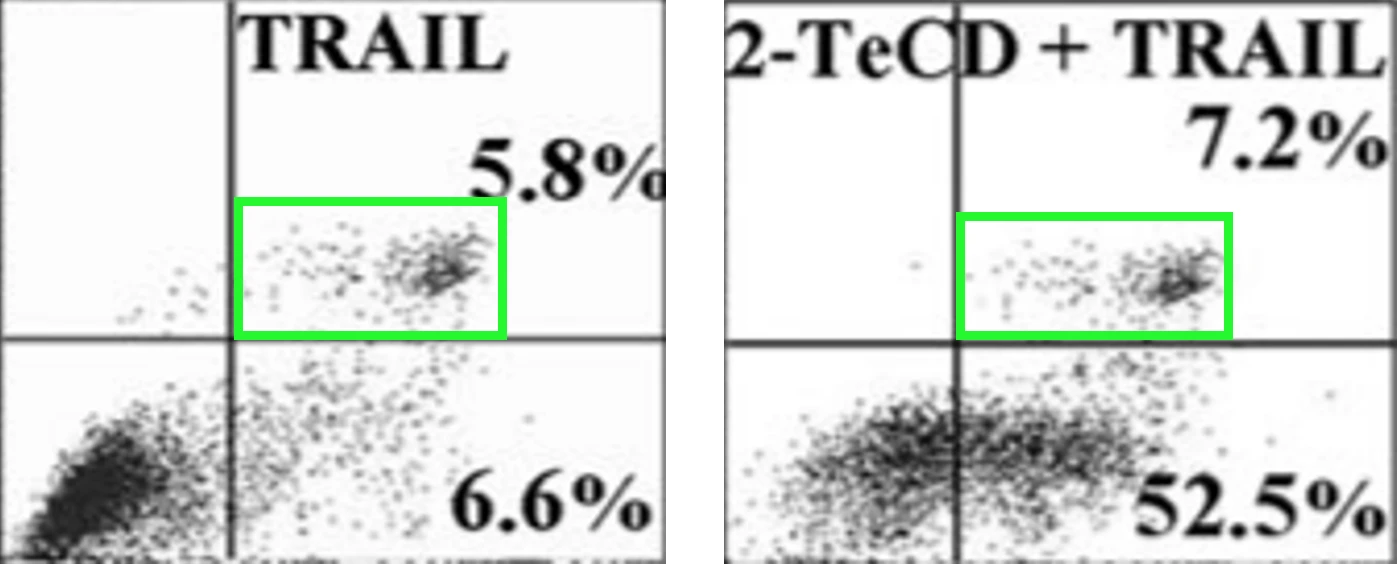
There is also a second, bigger change. Until now, Imagetwin detected duplications between FACS images. It can now also detect duplications within the same image, even when the duplicated area is only a tiny fraction of the entire plot.
That matters because FACS duplications are often small: a handful of dots copied into another region of the same quadrant, or a single cluster repeated across a plot.
What this looks like in practice
The examples below are real FACS duplications flagged on PubPeer. In each case, the copied area is only a small part of the plot and easy to miss by eye, but was successfully detected by Imagetwin.
How we evaluated it
To measure performance on real cases, we built a test set of genuine FACS duplications reported on PubPeer and mixed them with distractor images.
- Real duplications (315 cases) are used to measure the detection rate (true positive rate): how many actual duplications the method finds.
- Distractor images (3,585 images) are used to measure the false alarm rate (false positive rate): how often the method flags something that is not a duplication.
We made the distractor set deliberately difficult. Using hard mining, we selected images that already look very similar to each other. A random pool of FACS images would contain too few look-alikes to put the method under real pressure, and the false alarm rate would look better than it actually is.
The test set was never used during training, so the results reflect performance on images the model had not seen before.
Results
- Detection rate: 98.4% (310 of 315 real duplications found)
- False alarm rate: 0.08% (about 3 false alarms across 3,585 distractor images)
For integrity teams, this means more real issues caught, with very few extra images to review.
What's next
Over the next few weeks, we will roll out the same technology for XRD (X-ray diffraction) duplicates.
The new FACS detection is already live for all Imagetwin users. No action needed on your side: your next check will use it automatically.