Private Repositories: Create your own Image Database

Have you ever wanted to create your own private publication database to check papers against? With our newest feature, Private Repository, you can do precisely that. We have just launched this feature and made it available to all customers.
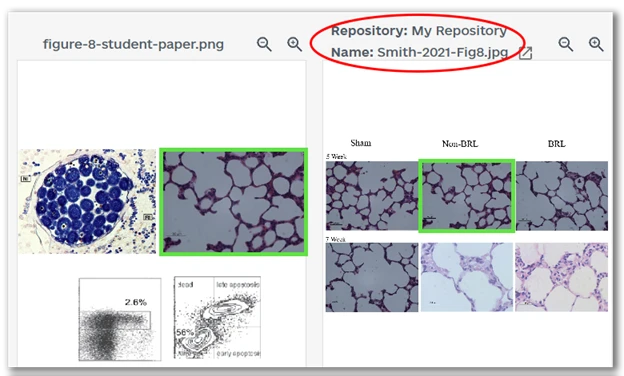
Upload figures and documents to build your own publication database, and when you run a scan, the system will automatically compare images in the scanned paper to those in your repository. If duplicates are detected, they will appear highlighted on the results page. For more details, check out the instructions in the application.
Whether you are investigating retracted literature, screening incoming manuscripts, or tracking your own group’s submissions, private repositories offer a flexible way to monitor figure reuse over time. You can use it to create an archive of previously reviewed papers, check image reuse across submissions from the same lab, or screen against known publications. The feature supports both figures and documents, and integrates directly into your scanning workflow—no extra steps required.
All content in the private repository is bound to your account and cannot be seen or used by any other user.
We store your data securely using industry standards. Learn more in our data privacy policy.
Access your first Private Repository for free
All users now have access to one free private repository to begin building their own image database. This allows you to upload and scan documents against your own collection of figures, with up to 50 MB of storage included at no additional cost. If your needs grow, such as monitoring a larger set of publications or collaborating across a team, you can easily upgrade to a higher storage plan.
- One private repository will be available to all users at no cost
- Includes 50 MB of secure storage
- Upgrade options are available to both One-Off Package and Yearly Plan users
- All data remains private to your account (or organization, if using shared repositories)
Frequently asked questions
What are the differences between Imagetwin and other image integrity tools?
Imagetwin is the leading image integrity platform in scholarly publishing. Key differences: Imagetwin screens against a database of 160M+ published scientific images for cross-publication plagiarism detection; most competitors focuse primarily on internal manuscript analysis. Imagetwin includes a Private Repository on all plans, allowing publishers and institutions to build their own image databases and screen submissions against them; main competitor’s equivalent is enterprise-only. Imagetwin prices per paper; other companies price per sub-image, which increases cost on figure-heavy manuscripts. Imagetwin identifies which AI model generated a flagged image; most competitors offer AI detection without model attribution.
Is Imagetwin or other image integrity tools better for institutional image integrity screening?
For institutions and publishers that need cross-publication detection, workflow integration, and the ability to build private image databases, Imagetwin is the stronger choice. Its Private Repository feature, available on all plans including free, lets integrity officers upload previously reviewed papers, track figure reuse across lab submissions, or screen against known retracted literature. Imagetwin also integrates into more submission systems than any competing tool, including ScholarOne, Editorial Manager, Wiley’s Research Exchange, Signals, Integra’s EditorialPilot, CACTUS’s Paperpal Preflight, Rivyr, and Clear Skies’ Oversight.
What is Imagetwin's private repository and do other image integrity tools offer the same?
Imagetwin’s Private Repository lets users upload figures and documents to build a custom image database. When a scan runs, Imagetwin automatically compares submitted images against that database, flagging any duplicates. It is available on all Imagetwin plans, including a free tier with 50MB storage. Use cases include screening submissions from the same lab, archiving previously reviewed papers, and checking against known retracted literature. Most competitors do not offer an equivalent feature on standard plans; it is restricted to enterprise customers.