Conversation with a Sleuth: How XRD Plot Duplication Happens, and How to Catch It

X-ray diffraction plots were considered nearly impossible to screen for duplication, until recently. In our recent webinar, Imagetwin co-founder and CTO Marcus Zlabinger sat down with Mu Yang, PhD, a behavioral neuroscientist at Columbia University Medical Center who has become one of the most active research integrity sleuths working in XRD, glass, and spectra images. She walked through how she spots duplicated traces by eye, and Marcus shared what Imagetwin’s new automated XRD detection feature found when it was pointed at thousands of recent papers.

What is So Difficult about XRD Plots

XRD is used to confirm that a material’s crystal structure matches what a paper claims, and the peaks, widths, and baseline noise in a trace all carry real information. That also makes XRD data relatively context-poor compared to, say, a microscopy image, which is exactly why it took so long for any automated tool to reliably flag duplication in it. Peaks and baseline noise are the two things Mu Yang sees edited most often.

Four Things a Clean Trace Should Never Do

Before getting into specific cases, Mu Yang laid out the basics she checks on every plot: 

  • Traces should never travel backward
  • Baseline noise is stochastic and should never repeat within or across traces
  • Every point should have one x and one y value
  • Unexplained line breaks are a red flag.

Common Issues and Red Flags

The three issues she flags most often are: 

  • Reused traces (usually the noise sections get recycled)
  • “Patchwork” (chopping up traces and reassembling them to look new)
  • Hand-drawn traces, which she says are the hardest to catch because they don’t always break a specific rule, they just look wrong. 

On top of that, three visual cues tend to give away an edited plot: 

  • Unusually thick or chunky lines (easier to hide a seam in)
  • Mislabeled axes (wavenumbers on an axis that should read 2-theta)
  • Fuzzy axes, which often mean two images were stacked to fake a new trace.

How to Spot Issues in XRD in Practice

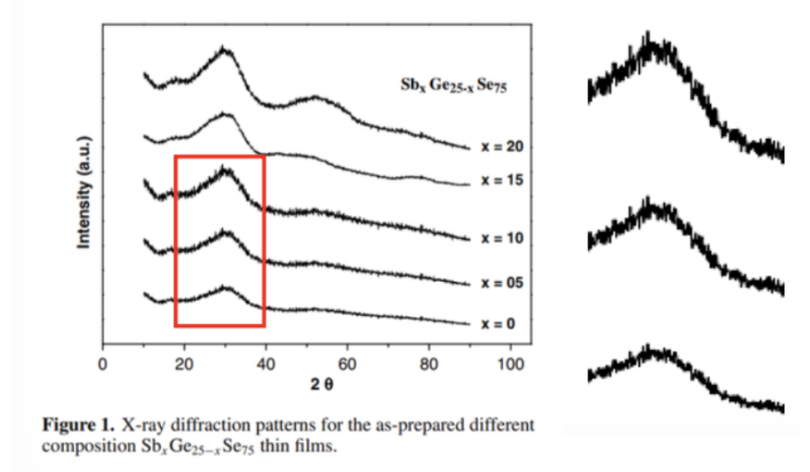
The core technique: anchor your eyes on one small section of the plot, say around 2-theta = 40 degrees, and run them straight down across all traces rather than scanning the whole figure at once.

Five XRD traces for different Sb-Ge-Se thin film compositions. Anchoring on the boxed section and scanning straight down shows the same trace repeating across all five, supposedly independent, samples.

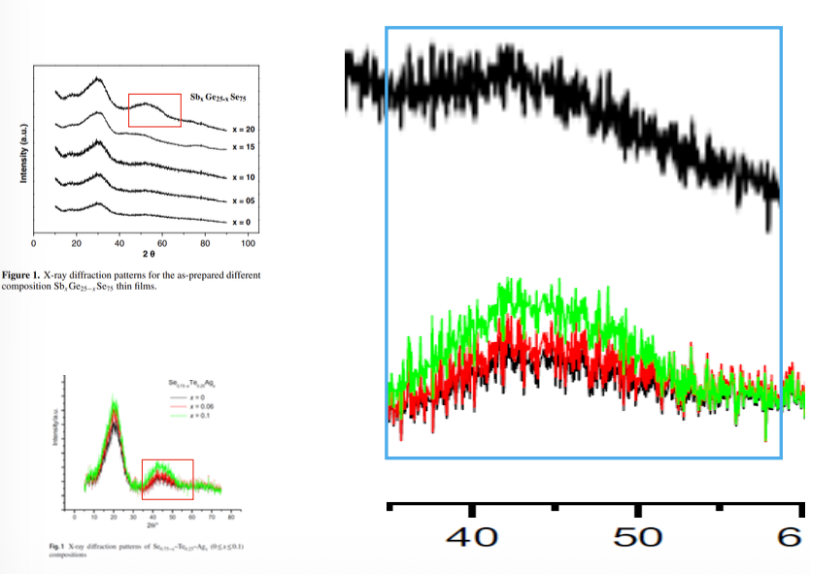
The trickier lesson: traces that look completely different can still share the same underlying data, just with color, intensity, or waveform shape altered.

Two XRD figures from two different papers that look unrelated at first glance, until the same section is isolated and compared side by side: the baseline noise is nearly identical.

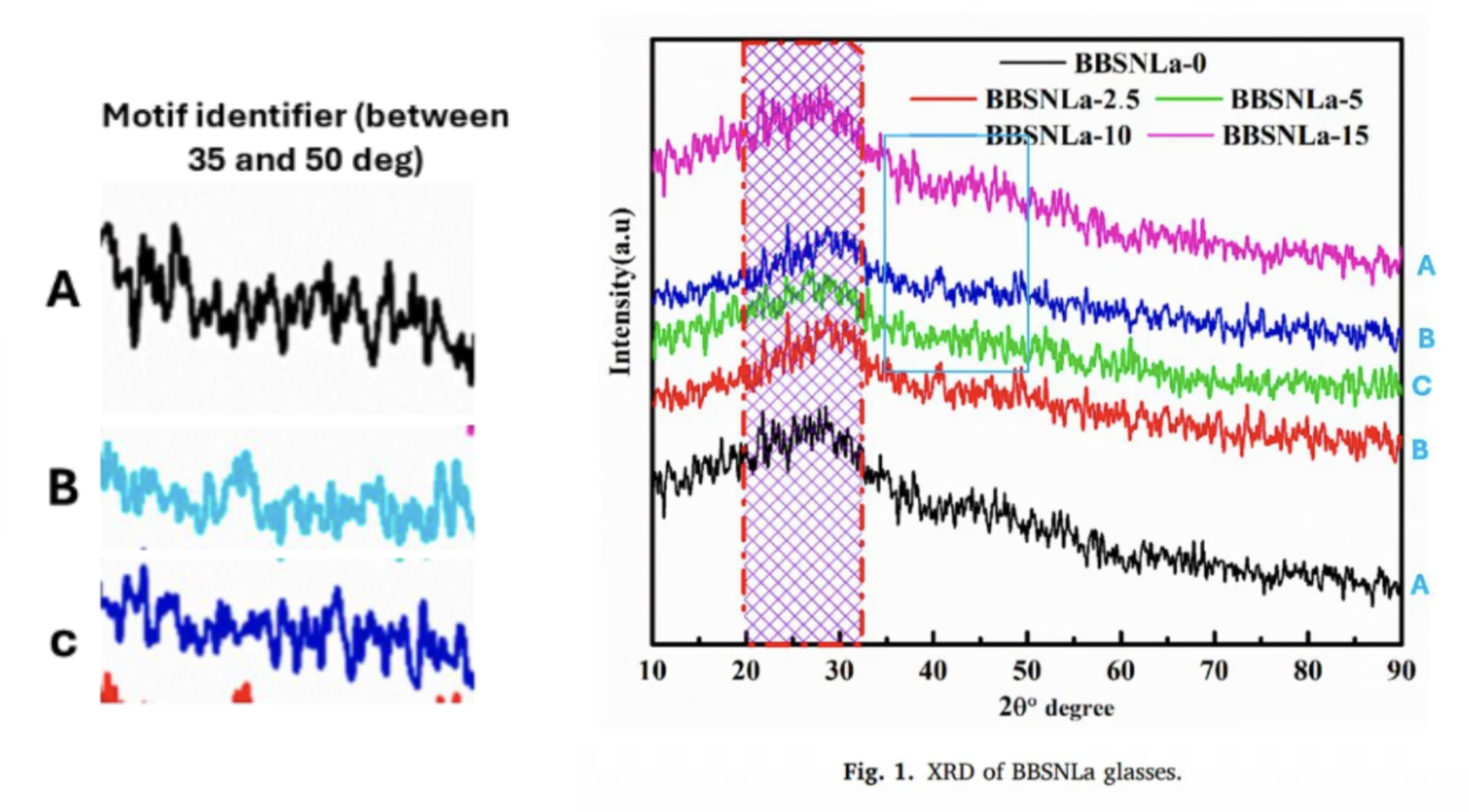
In one case study, she found just three recurring trace “motifs” reused across 72 different papers, once she built a visual key to spot them.

Motifs A, B, and C, each one reused across dozens of papers with only the color, intensity, or waveform shape changed to disguise it.

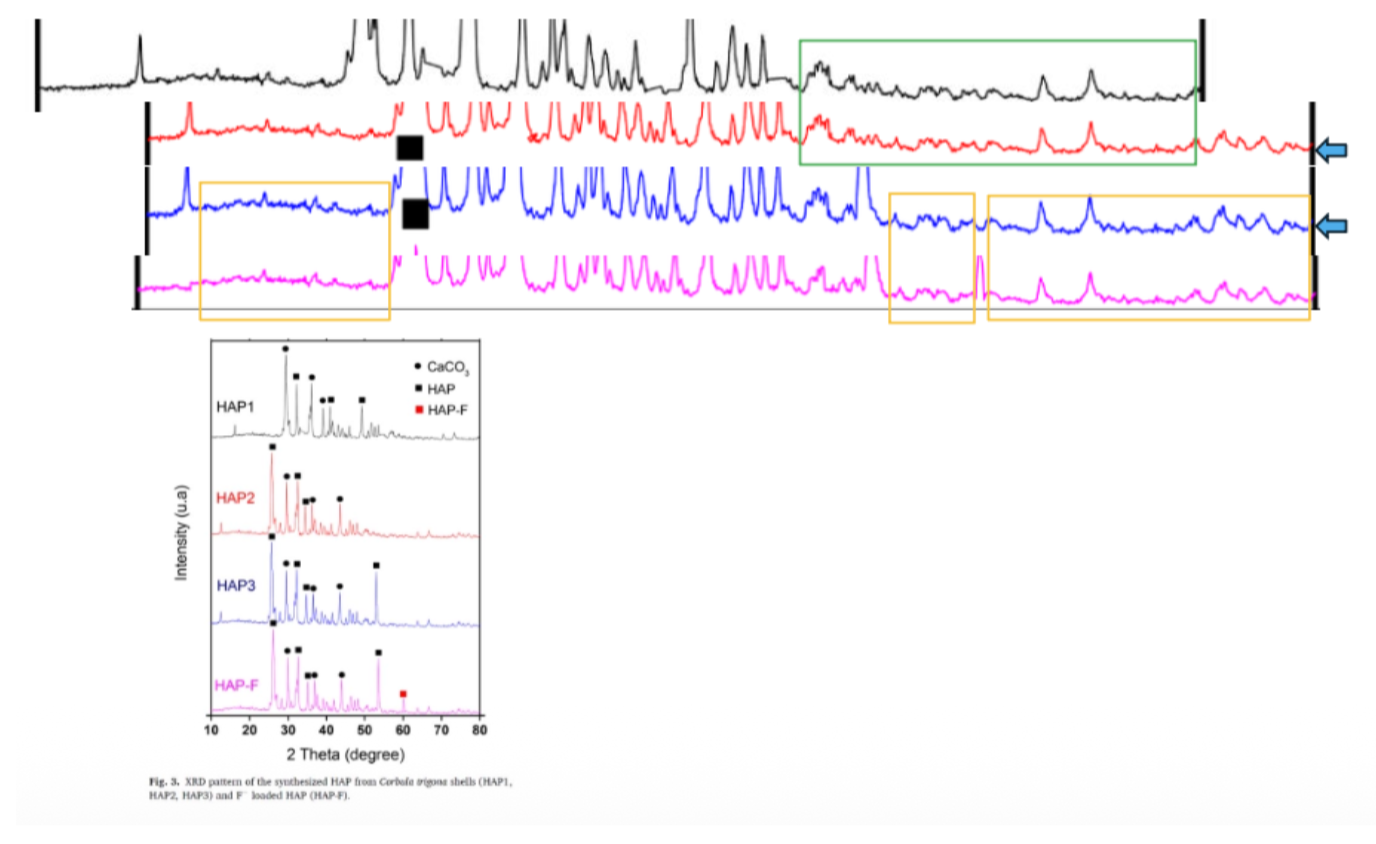
Patchwork is easiest to catch once you zoom into the image file itself, not the PDF preview.

The boxed sections show the same baseline noise recycled across panels within a single figure.

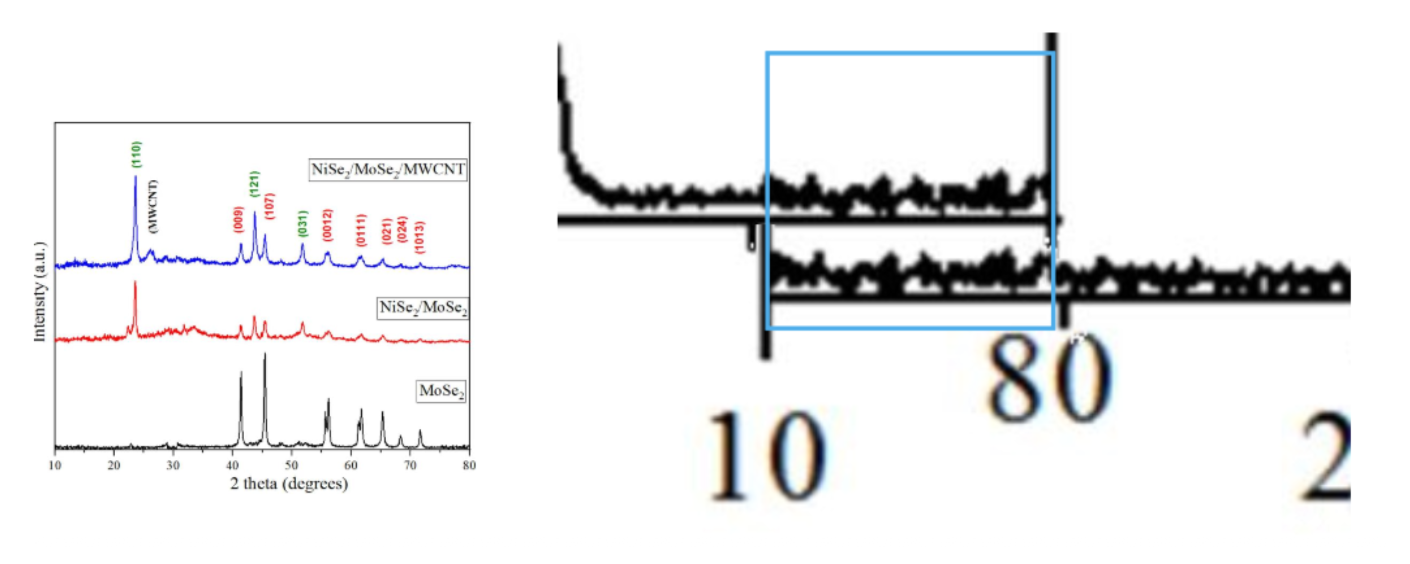
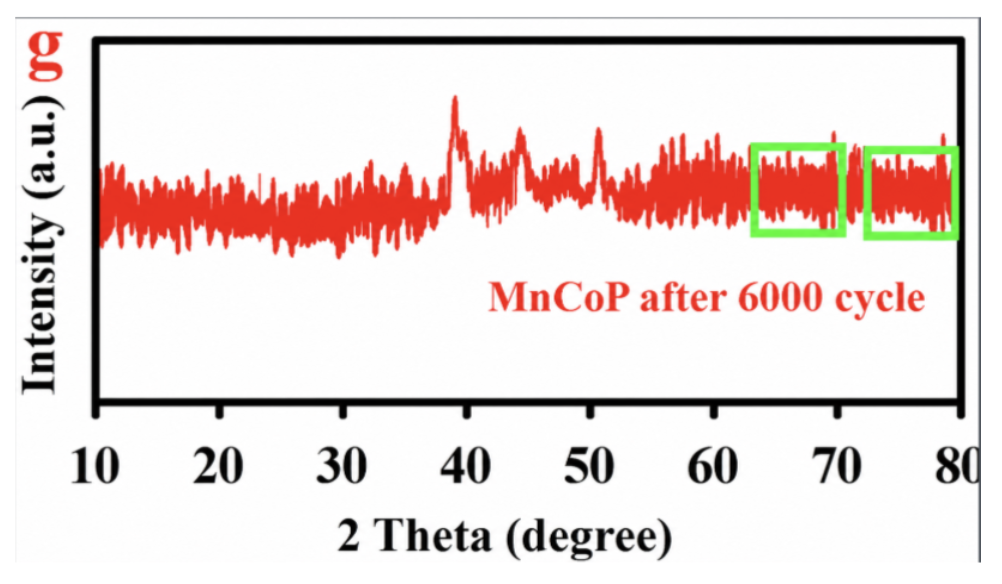
Two more visual tells: pay attention to where traces end, since editors tend to focus effort on the middle of a figure and get sloppy at the edges, and treat unusually thick traces with suspicion, since a thick line makes it easier to hide a seam.

The 10-degree and 80-degree ends of this trace carry matching noise, a spot editors often overlook.

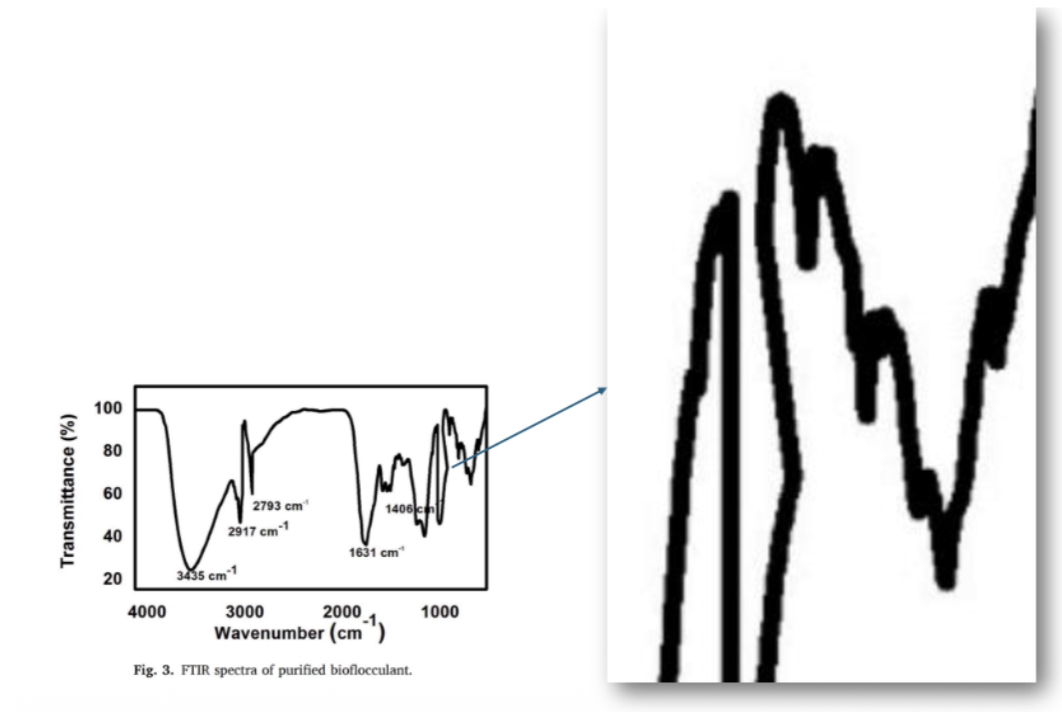
And then there’s the hand-drawn category, images that clearly didn’t come from an instrument but don’t technically violate any named rule, until they do, like a trace that abruptly reverses direction.

A hand-drawn trace pasted into an FTIR plot, from a paper that has since been retracted. Zoomed in, it backtracks on itself, something no real instrument trace can do.

Mu Yang's Field Tips

  • Anchor your eyes on a small section and remember it before scanning vertically across traces.
  • Review the actual image file, not the version embedded in a PDF.
  • Watch for chunky traces and check the ends of every plot.
  • Binge a suspicious author’s papers in one sitting. Working memory fades fast, so cluster the review.
  • Use the figure preview tools some publishers already offer (e.g. ScienceDirect).
  • Zoom in. Always zoom in.

Imagetwin’s Vision is to Strengthen Manual Screening with Automated Detection

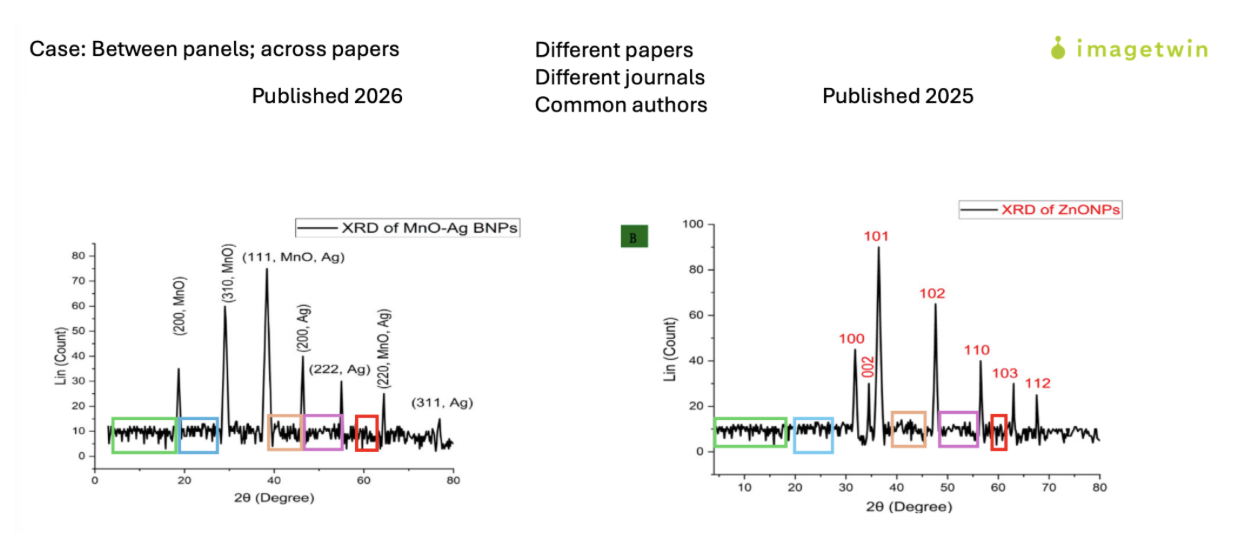
Marcus shared results from scanning 4,716 papers with XRD plots published in 2026: the new cross-paper reference database of over 374,000 XRD plots flagged 428 same-panel matches, 181 same-paper cross-panel matches, and 43 cross-paper matches, including cases spanning different journals with shared authors.

Imagetwin's cross-paper detection flagging matching XRD panels in two different papers, different journals, published a year apart, with authors in common.

On the roadmap: 

  • Expanding XRD cross-paper detection through Q3/Q4 2026
  • Bringing the same cross-paper matching built for XRD to other sub-image types, including graphs, diagrams, and plots
  • A next-generation manipulation detection model
  • Expanded AI-image detection support, including for ChatGPT Images 2.0.

Appreciation

All the examples, techniques, and insights in this recap come directly from Mu Yang. Thank you so much for generously sharing your expertise and your eye for detail with the community.

Watch the webinar recording on our Youtube or LinkedIn.

How Imagetwin Detects Manipulation in Western Blots, Microscopy, FACS, XRD Plots, Graphs, and More

Usually, automated image integrity screening is associated with Western blots, microscopy panels, or FACS plots. Those image types carry the visual evidence in biomedical research, and they were the first to attract systematic fraud.

But scientific publishing extends well beyond the life sciences. Materials science, chemistry, physics, engineering, these fields rely on their own visual evidence: XRD patterns, spectra, chromatography traces, line graphs. Figures that look nothing like a blot, but should be looked into just as much. 

Imagetwin has detected integrity issues across all of these figure types for over two years. We have put together a couple examples to show you what it looks like in practice, and what our latest technology update improved even further: detection of duplicate areas hidden within a single trace or plot.

Our Technology Started Detecting Issues Where the Risk Was Highest

Imagetwin was built to screen scientific figures at scale. We started with detecting duplication or manipulation in Western blots and microscopy images, and then expanded to cover the full range of figure types submitted to journals today.

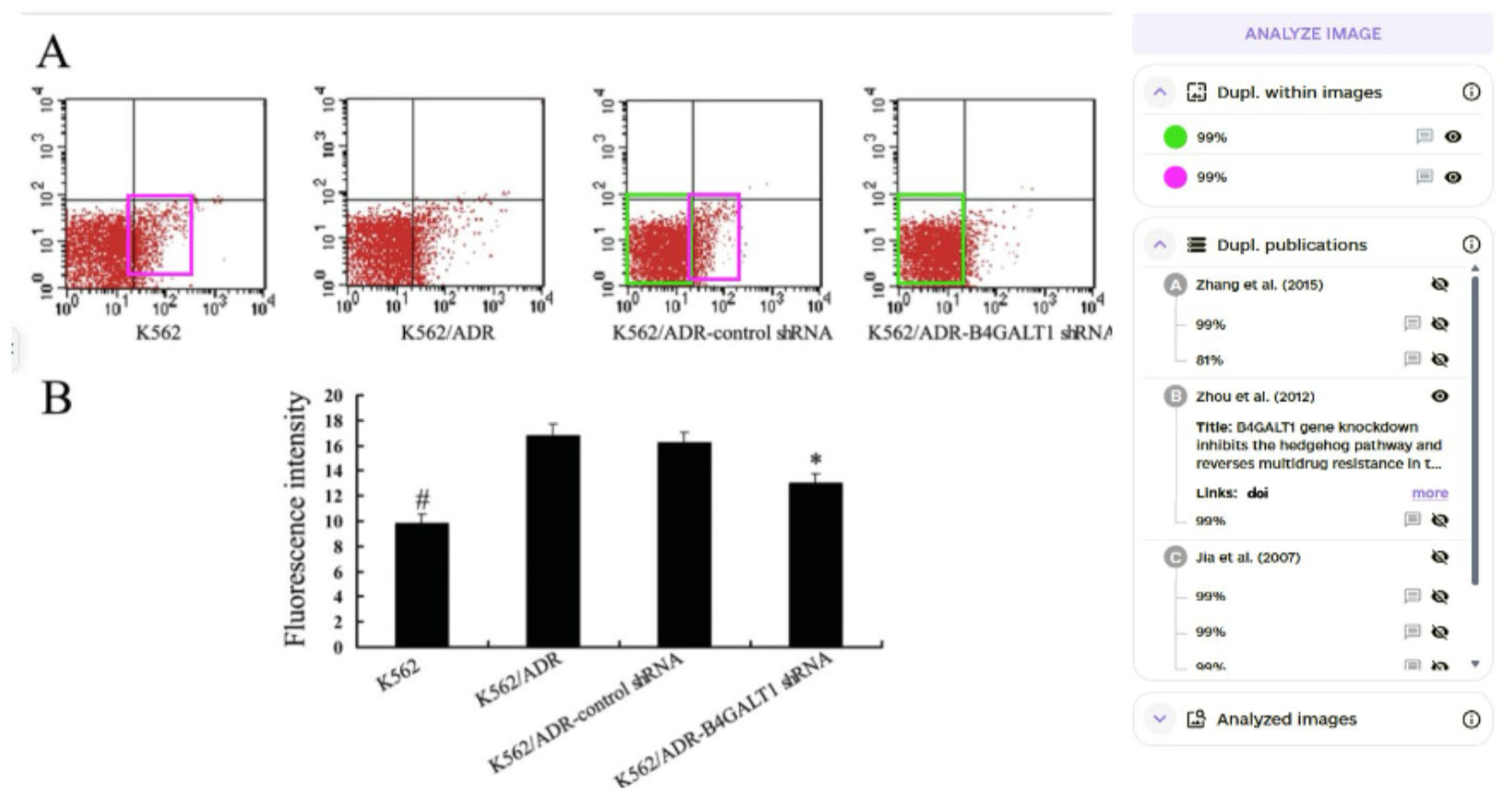
FACS plot duplicates detected within and across publications.
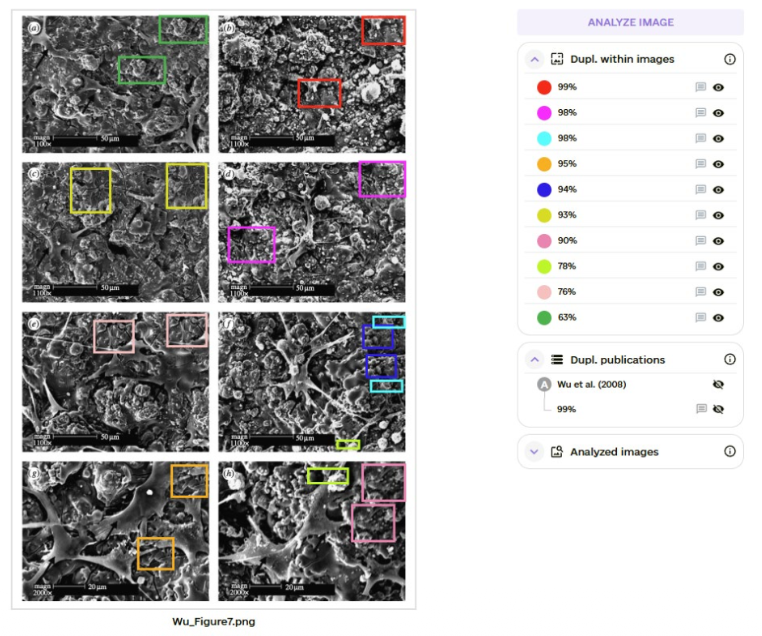
Duplicated image areas detected across microscopy panels. Multiple matches flagged.
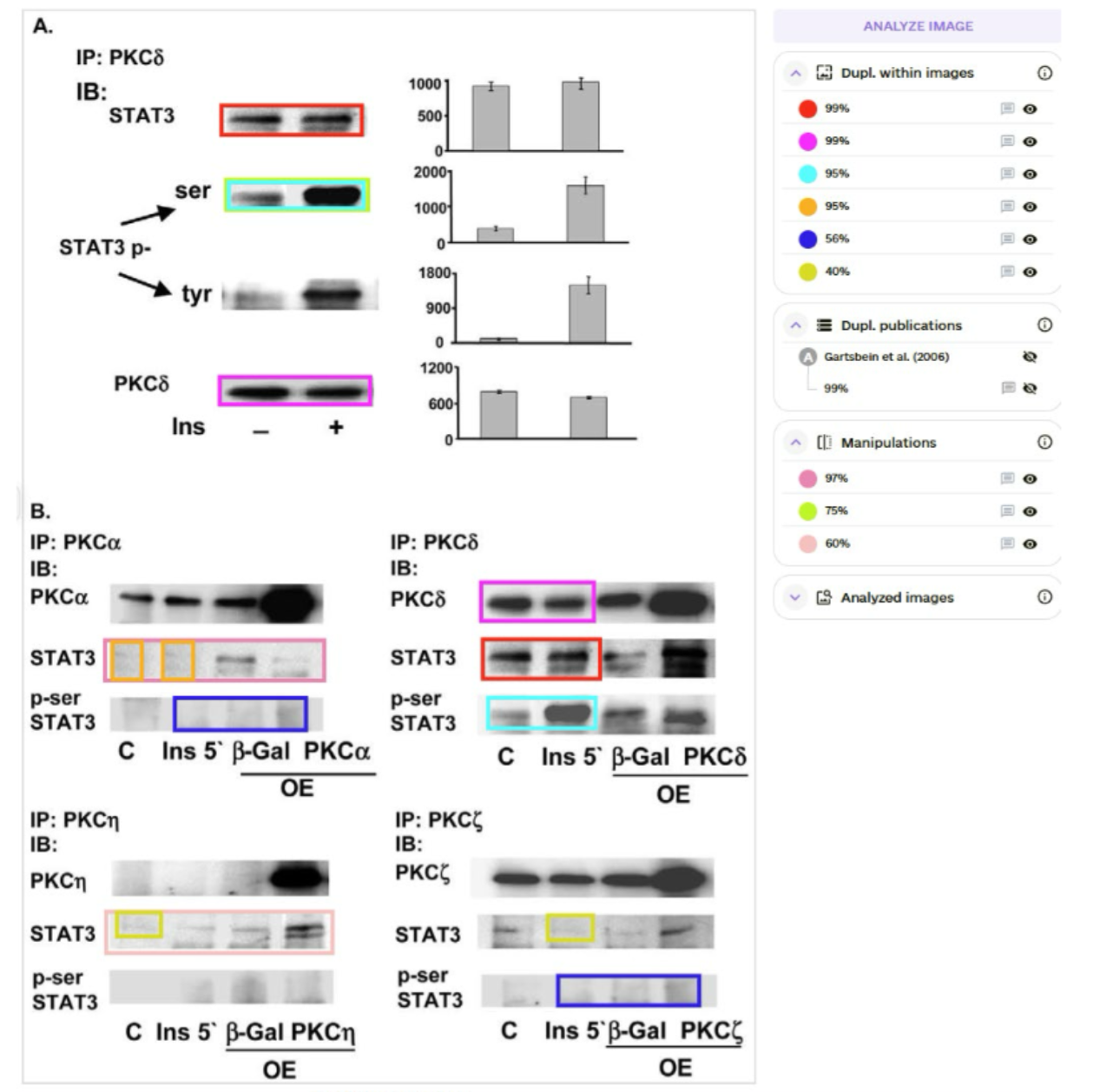
Western blot manipulation detected. Suspicious areas highlighted by Imagetwin's filtered image view.

Charts and Plots: The Blind Spot That Isn't Blind

XRD patterns, spectroscopy traces, and other plot-based figures have a specific vulnerability: their data is dense, visually similar across samples, and routinely manipulated by copying segments between panels or papers. Imagetwin detects both cross-paper duplication and within-paper panel manipulation in these figure types.

Imagetwin has been screening this figure type for over two years. Now, the level of detection is even stronger with the update of our technology.

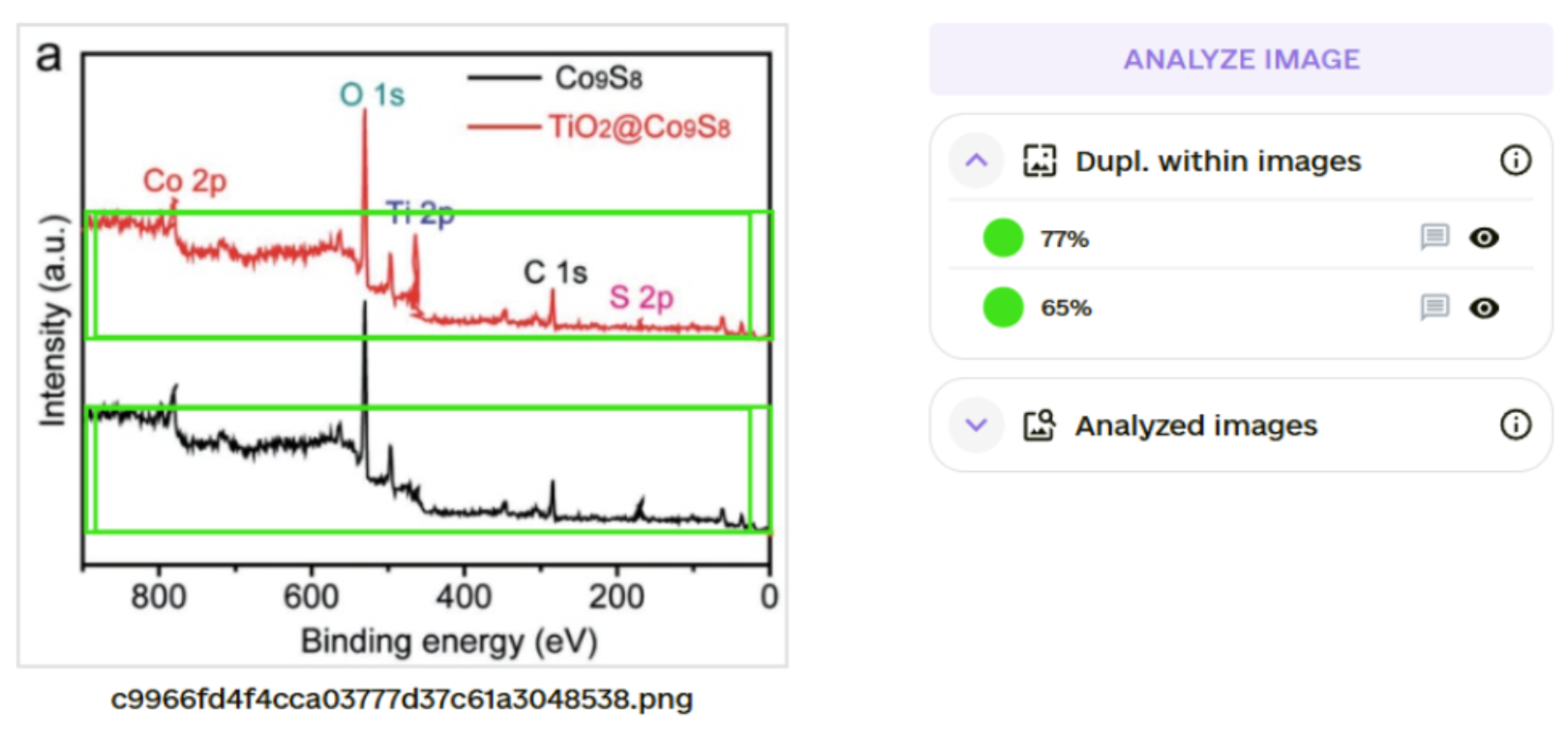
Duplicate segments identified across spectroscopy panels.
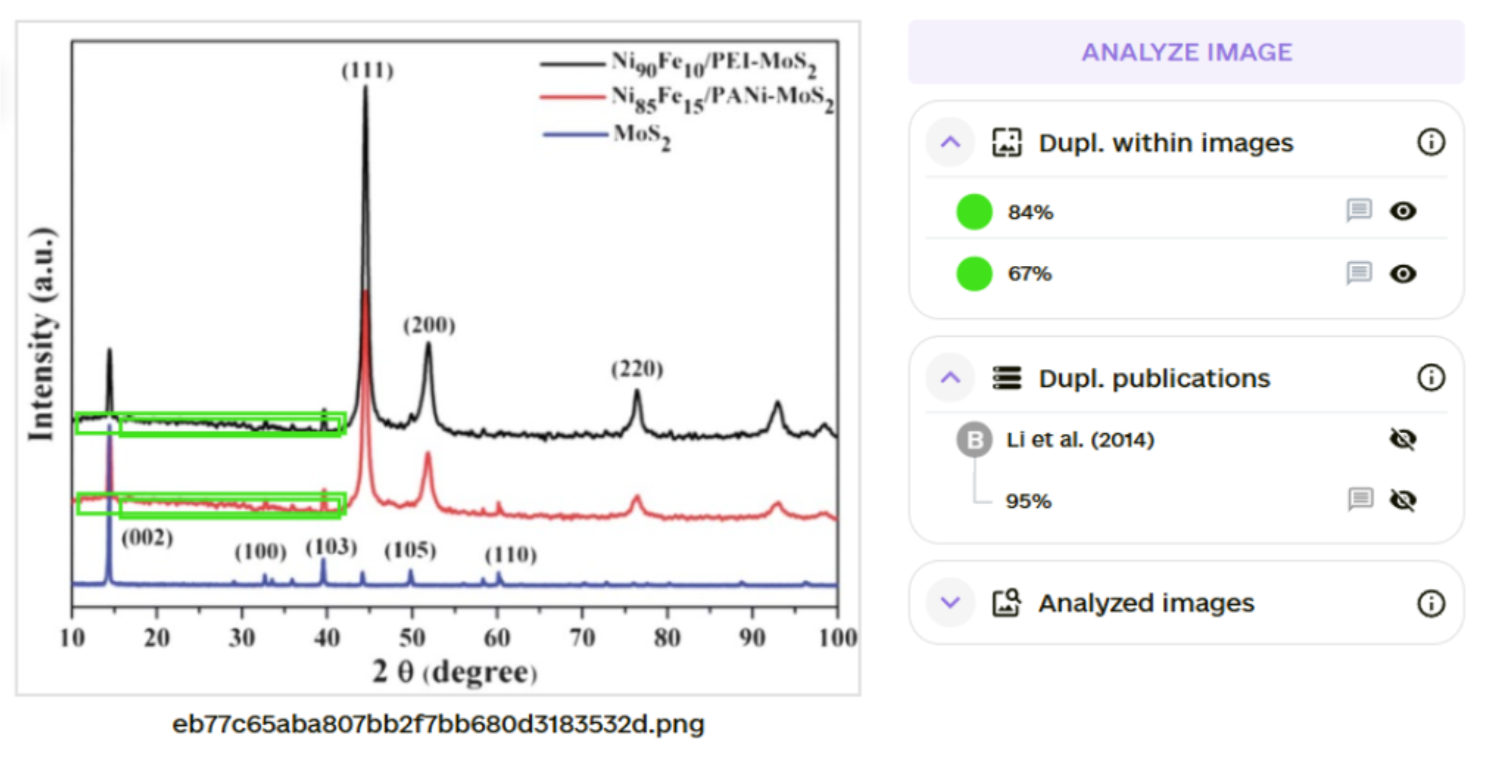
XRD trace duplication detected within a single figure. Two trace segments flagged as identical.

New: Trace & Plot Duplicate Detection (BETA)

Spectra, chromatography traces, and XRD plots share a common manipulation pattern: a segment from one part of the figure is copied and pasted elsewhere, sometimes within the same panel, sometimes across panels, sometimes across papers. The repeated region may span only a fraction of the full trace. It’s nearly impossible to catch visually at submission scale.

Imagetwin is the first and only solution on the market that detects duplicate segments hidden inside line graphs.

Trace & Plot Duplicate Detection (now in BETA) automatically identifies repeated segments within and across figure panels of a submitted paper. It works on the types of figures that have long been a blind spot in image integrity screening.

Duplicate trace segment detected within an XRD plot. The repeated region spans approximately 10 degrees of 2-theta.

AI-Generated Figures: Detection Across Models

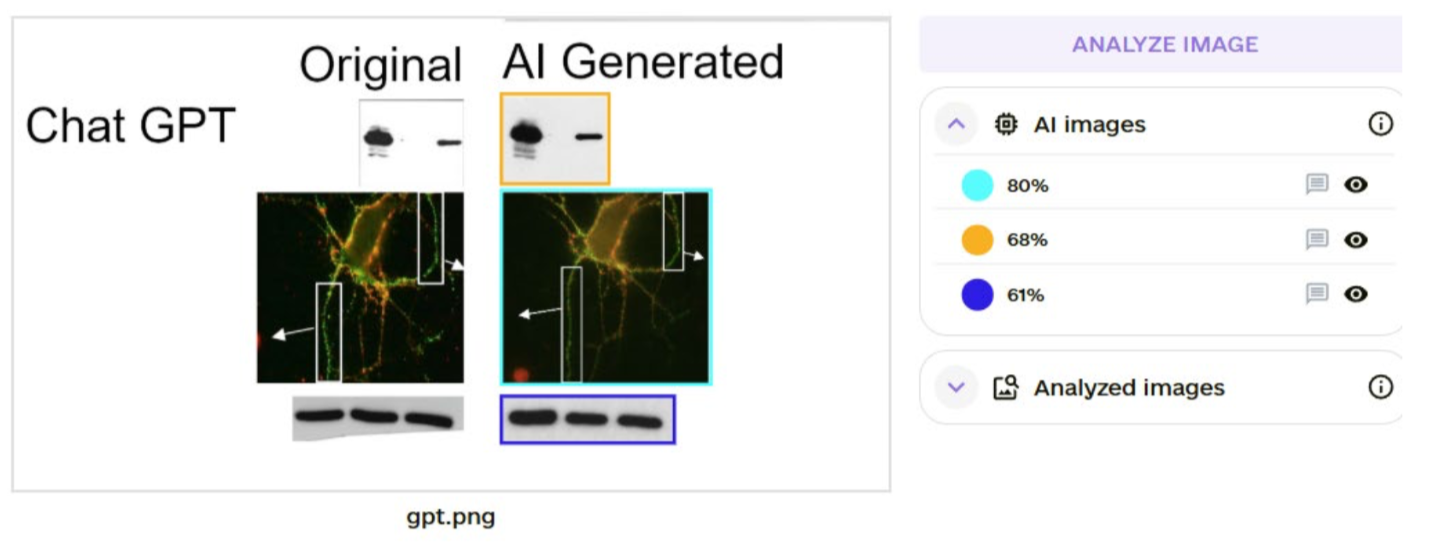
The integrity risk isn’t limited to duplicated real data. AI-generated scientific figures, produced by GPT, Stable Diffusion, DALL-E, Firefly, and others, are an emerging and growing concern. Imagetwin detects these too, including when C2PA watermarks have been erased and detection must rely on image content alone.

For images carrying the C2PA watermark, the standard adopted by Adobe, Google, Meta, and others, detection confidence reaches 100%.

AI-generated figures detected by Imagetwin.

What This Means for Institutions, Publishers, and their Integrity Teams

The practical implication is straightforward: a materials science submission, a chemistry paper, a physics preprint, any of these may contain duplicated or manipulated figures, and manual screening at submission volume isn’t realistic.

Imagetwin screens submissions against a database of 160M+ images from published literature, flagging duplicates not just within a paper but across the entire database. That coverage spans blots, microscopy, FACS, XRD, spectra, and AI-generated images, and now includes partial segment duplication within traces and plots.

Try Trace & Plot Duplicate Detection now on our app.
Frequently asked questions

Imagetwin screens Western blots, microscopy panels, FACS plots, XRD patterns, spectroscopy traces, chromatography traces, line graphs, and other plot-based figures. Coverage extends beyond biomedical images to materials science, chemistry, physics, and engineering figures. Imagetwin detects all life sciences related image types.

Yes. Imagetwin is currently the first and only solution on the market that detects duplicate segments hidden inside line graphs, spectra, and XRD plots.

Over two years. The recent update strengthens detection specifically for partial, within-trace segment duplication, which was previously a blind spot even with existing screening.

Imagetwin Named Finalist for the ALPSP Award for Innovation in Publishing 2026

We’re proud to announce that Imagetwin is a finalist for the ALPSP Award for Innovation in Publishing 2026, recognized alongside Alchemist Review Journal Fit, Thoth Open Metadata, Duplicate Review Checker, and FigureTwo. The award, run by the Association of Learned and Professional Society Publishers (ALPSP), celebrates new developments that add real value to scholarly communication.

About the ALPSP Conference 2026

The ALPSP Annual Conference and Awards looks beyond scholarly publishing for inspiration this year, opening with a keynote from science communicator Suze Kundu and running through plenaries on cross-industry innovation, research funding pressures, and community engagement. Three key topics will be discussed this year: 

AI and Editorial Workflows

AI is reshaping how manuscripts get screened before publication, and the conference’s parallel session on Lean Editorial digs into exactly that, including new perspectives on where AI fits in editorial workflows. It’s the same shift driving demand for automated image integrity screening: editors are expected to catch more, faster, with smaller teams.

Research Integrity

The dedicated Research Integrity track brings toxgether voices from STM, United2Act, librarians, funders, and researchers to address the pressures facing the scholarly record today. Image manipulation and duplication remain among the most common, and most detectable, forms of misconduct, which is why this track sits closest to Imagetwin’s own work.

Beyond Publishing and Global Priorities

Other sessions look outward: cross-industry innovation, publishing and the SDGs, diversifying global author pipelines, M&A in scholarly publishing, and open access/preprints. Together they frame a conference less about defending the status quo and more about how the community adapts.

Our Award Finalist Session

As a finalist, Imagetwin has a slot in the Awards Finalists Lightning Presentations, Wednesday 9 September, 16:15–17:15, chaired by David Sommer. We’ll have 7 minutes to talk image integrity: why it matters, where the biggest gaps still are, and how AI-assisted screening is changing what’s possible to catch before publication.

Our technology helps publishers, institutions, and researchers detect image duplication, plagiarism, manipulation, and AI-generated figures, the exact kind of innovation this award was built to recognize.

Sign Up & Let’s Meet in Manchester

The ALPSP Annual Conference and Awards 2026 runs 9-11 September at The Manchester Deansgate Hotel, UK. Winners are announced at the conference dinner on Thursday 10 September. For registration and the full programme, visit the official ALPSP conference page. Imagetwin Co-Founder and CEO Patrick Starke will be on-site for the full conference. If you’re attending and want to talk about image integrity workflows, screening at scale, or anything else, get in touch to set up time to meet in Manchester.

About Imagetwin

Imagetwin is an AI-powered image integrity software built to preserve trust in academic research. The tool detects integrity issues in research publishing, including image duplication, manipulation, plagiarism, and AI-generated content. Imagetwin’s database includes over 160 million academic images. It is a fast, reliable, and secure image integrity software for every submission.

If you’d like to learn how Imagetwin supports research integrity or explore potential collaboration, reach out to our team.

Frequently asked questions

Image duplication and manipulation are among the most common and most detectable forms of research misconduct. Undetected, they can lead to retractions, damage institutional credibility, and undermine trust in the published scientific record.

The main differences are pricing model (per paper vs per sub-image), database breadth (160M+ figures vs PubMed only), speed (seconds vs minutes), and AI detection scope. Imagetwin also offers generator attribution and a free private repository on all plans.

Imagetwin Is Now Integrated with eJournalPress (EJP)

You asked, we delivered: Imagetwin is now integrated into eJournalPress‘s EJPress, a widely used online manuscript submission and peer review platform from Wiley. This integration brings automated image integrity screening directly into a workflow that already serves a large base of scientific, technical, and medical publications.

eJournalPress has been building manuscript submission and peer review software since 1999, one of the earliest players in the space, and today serves publishers across the scientific, technical, and medical (STM) fields. With Imagetwin now part of that toolkit, editors can add image integrity checks to the list of things EJPress already handles well.

With Imagetwin integrated, editors using EJPress can detect image duplication, manipulation, plagiarism, and AI-generated figures directly within their existing submission workflow, without switching tools or exporting files elsewhere. Issues get flagged earlier, when they’re easiest to address.

This integration is now live in EJPress. As image-based misconduct becomes harder to catch by eye alone, we’re glad to make automated screening available to more publishers wherever their editorial process already runs.

About eJournalPress

eJournalPress provides customizable software for scientific, technical, medical, and engineering publications. Its core products, EJPress and JPS, cover the full editorial lifecycle from manuscript submission through peer review to production tracking.

Frequently asked questions

Yes. Imagetwin is trusted by some of the world’s largest academic publishers, including Wiley, Karger, Sage, and the American Society for Microbiology (ASM). Wiley integrated Imagetwin into Research Exchange, its platform used by more than 1,500 journals, making it one of the largest publisher deployments of AI-powered image integrity screening to date.

Yes. Imagetwin integrates directly into publisher workflows, including Wiley’s Research Exchange. When a manuscript is submitted, Imagetwin automatically screens images and delivers results within the existing editorial interface, no separate login or disrupted workflow required. Integration with additional submission systems is also available.

Imagetwin is integrated into active screening workflows at major publishers including Wiley, Karger, and Sage, and is used by research integrity teams across institutions and universities globally. In a pilot at ASM, Imagetwin flagged image integrity concerns in around 15% of accepted manuscripts, demonstrating real-world detection at scale. Imagetwin is a leading tool in scientific image integrity; Imagetwin differentiates on cross-publication duplicate detection, publisher workflow integration, and per-paper pricing.